
Segregated Arlington
In 1870, many white and African American Arlingtonians lived and worked on farms in close proximity to one another. 1 Over time, national housing policies and real estate business practices increasingly promoted the development of white-only communities, leaving little room for African Americans or others who were not considered “Caucasian.”
A segregated Arlington was marked by the frequent displacement of those living in African American communities. While living within these color lines of segregation, African Americans cultivated strong community bonds, leveraging limited resources within their neighborhoods to create a buffer from racial discrimination and to provide shelter when confronted with involuntary relocation. The accounts shared by members of the African American community, including oral histories that are available in the Charlie Clark Center for Local History, help us reconstruct more of Arlington’s housing history and understand both the discrimination as well as the resilience and activism of those who navigated Arlington’s color line. 2
Living in Arlington County was attractive to white and African American residents, albeit for some different reasons. According to one white real estate developer, many of the new residents coming to Arlington in the 1920s selected the county as their home because of “the race proposition.” 3 Although there is no explanation of what was meant, 1920 census data showed an increasing number of white residents. 4 It is reasonable to assume that reference to race indicated that prospective residents sought Arlington for a segregated lifestyle.
Racial covenants that were added to property deeds played a pivotal role in segregating Arlington. The earliest racially restrictive covenant located for Arlington, appeared in 1900 in Clarendon. 5

Early racial restrictions also appeared in the 1924 charter of Arlington’s Town of Potomac. Billing itself as “the most progressive, aggressive, bustling community” in Virginia with both a fire department and sanitary sewers, the town charter made the following case for segregated living:
It is perhaps the only municipality in the United States in which ownership of real estate is limited to persons of the Caucasian race, and it is also the only municipality as far as known, that does not number among its residents persons of African descent. It’s growth in the past five years and since the installation of the sanitary sewer system has been phenomenal and nearly all the residents of the town are owners, industrious and progressive….
6
This type of racial restriction would be replicated in many Arlington subdivisions built over the next several decades. The practice of including racial covenants in land records created a network of segregation walls that persisted, well past their use, across Arlington neighborhoods, limiting who could live, rent, or own property. Some racial covenants specified targeted groups that were not considered “Caucasian” or white, such as “Negroes,” “persons of African descent,” or “non-Caucasians.” Others barred groups who were generally considered legally white, including “Assyrians,” “Syrians,” “Persians,” “Jews,” “Hebrews,” or the “Semitic race.” 7
In contrast to most “Caucasian only” recruitment efforts by other developers, the Washington Development Corporation launched Douglass Park as an exclusive “Colored only” subdivision in the 1920s. The Washington Bee reported that the
company was formed “for the purpose of securing choice locations for our people [African Americans] with money behind them to build desirable modern homes.”
8 Douglass Park was for “progressive colored people,” an idea that was notably the exception rather than the rule in Arlington.
9
The developer of Douglass Park marketed the homeownership opportunities for African Americans, noting “the fact that the negro is a citizen of the United States as much as any one else, and that as such he is entitled to all
the privileges that come to so exalted a citizenship.”
10 Subdivision plans for Douglass Park included parks, broad boulevards, a nine month grade school for “colored” children, and a gathering space for the Baptist Convention of the District of Columbia.
11 During this period, all schools in Virginia were segregated. The legislature would soon enact The Public Assemblages Act in 1926, which mandated all public gathering places also be segregated.
12
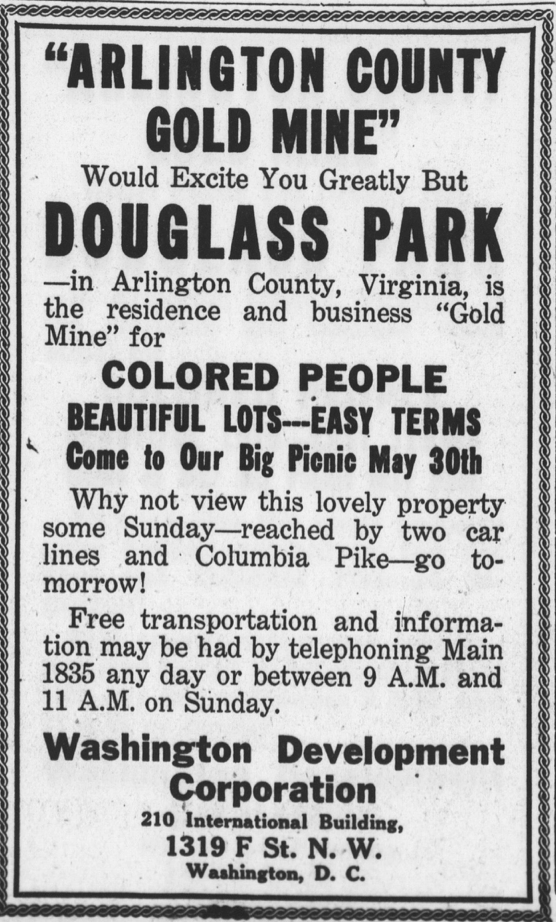

By the 1940s, the Washington Development Corporation faced multiple challenges and filed for bankruptcy. Subsequently, the Douglass Park subdivision changed hands several times among largely white developers/builders. For reasons not understood, some of the remaining lots in the subdivision were sold with the “Caucasians only” racial covenants while others contained covenants limiting occupancy to “members of the Colored Race.” 13 Although the contemporary spelling of the subdivision has dropped the extra “s” in Douglass, the area remains one of Arlington’s more integrated neighborhoods today. 14
Segregated living began well before 1900, when white and African Americans lived in locations throughout Arlington County. At that time, many African Americans worked on white-owned farms, often renting homes close to where they worked. 15 As farms were replaced with new subdivisions and roads and access to cars increased, so did residential segregation.
In the late nineteenth century, the largest number of African American Arlingtonians settled in southern sections of the county, near Freedman’s Village. Established during the Civil War, the Village was viewed as a model, featuring
duplexes that were constructed by the Freedman’s Bureau for formerly enslaved persons. Until the federal government closed it in 1900, those living at Freedman’s Village built a flourishing community that lasted decades longer than
had been intended.
16
Steve Hammond, a descendent of the Syphax family, walks viewers through the history of Freedmen’s Village. Click here to watch the National Archives Video Clip. 17
The Syphax family, descended from an enslaved woman named Arianna Carter and George Washington Park Custis, Martha Washington’s grandson, was among the earliest African American landowners in the part of Arlington County known as Rosslyn. 18 Like other African American families in Arlington, the Syphaxes were displaced multiple times. In 1863, their land was confiscated for back taxes owed by the former owner, Robert E. Lee. Again, in 1944, the federal government claimed portions of the land to build the what is today known as the Joint Base Myer-Henderson Hall. 19
Physical segregation imposed real boundaries between African American neighborhoods and adjacent white-only subdivision. In Halls Hill-High View Park, a concrete wall was built bordering the Woodlawn Village subdivision. 20
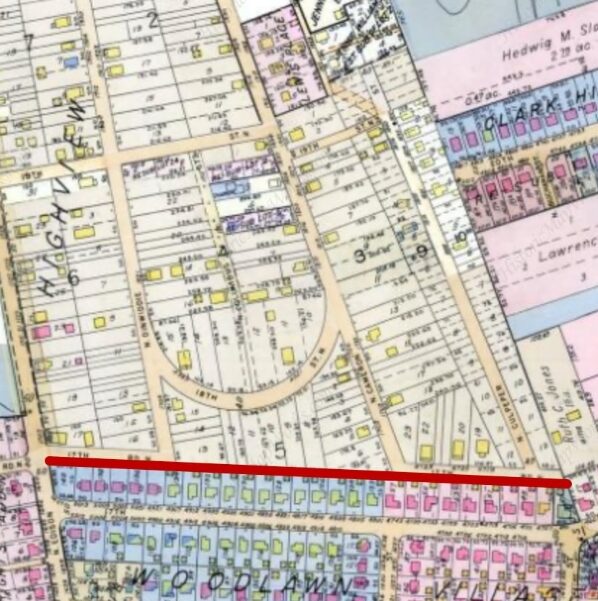
The red line on the map above shows the location of the concrete segregation wall that separated the African American neighborhood of Highview Park from the white subdivision of Woodlawn Village. 21
The county’s population growth meant continual displacement for many who lived in African American neighborhoods–the boundaries of which were being forced to shrink. As the county’s roads and water and sewer lines were put in place, the access to modern improvements lagged in African American neighborhoods. Pressure to sell often came from real estate investors or federal agencies that were looking to expand largely white only developments. In some cases, residents were forced to sell their properties. When African Americans relocated, they had fewer options within Arlington from which to choose.
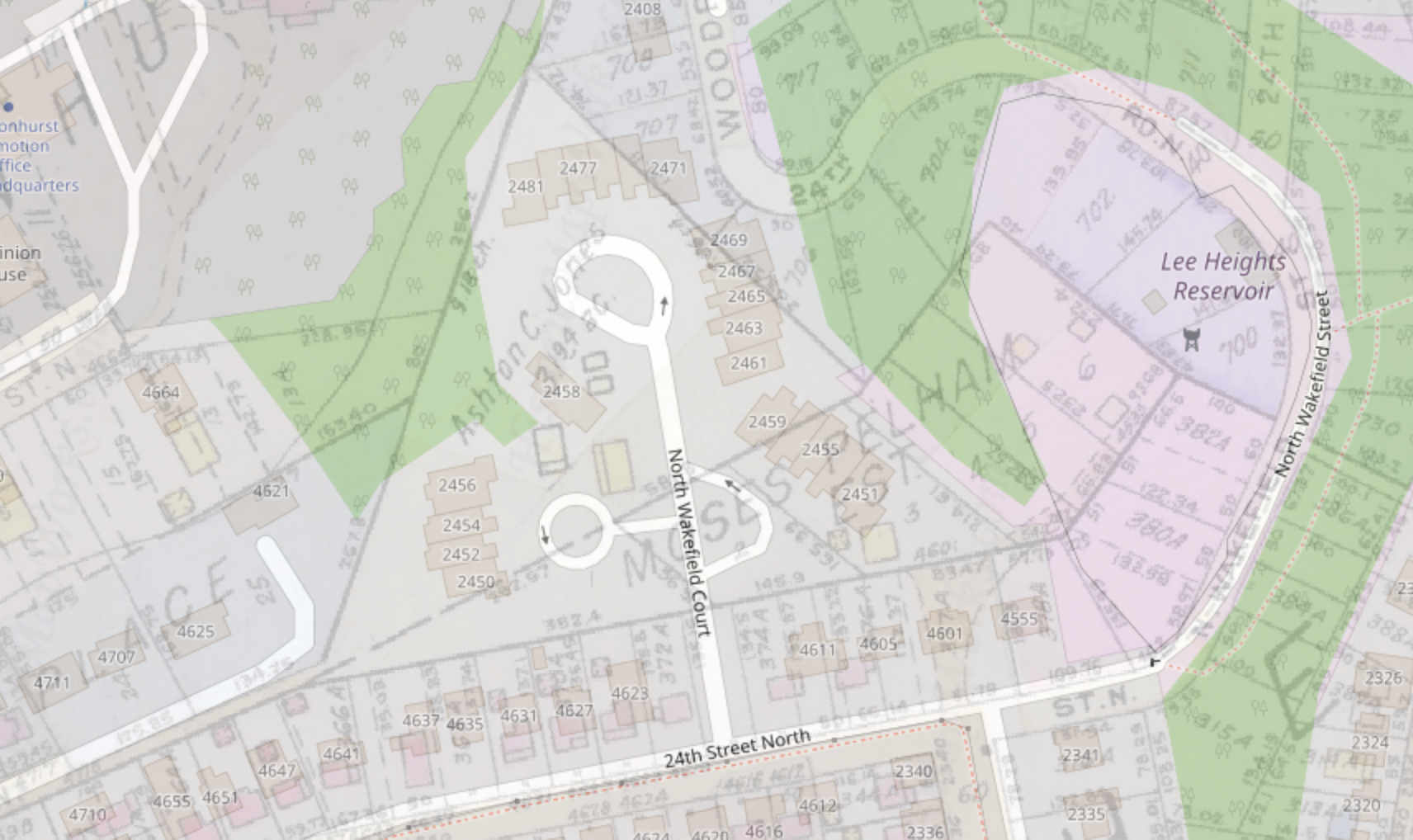
For example, the Pelham family owned a series of lots in the northern part of Arlington (see Pelham Town on map below). After Moses Pelham Sr.’s death, his land was disbursed in 1904 to his six children (Burrell, Gibson, Moses Jr., Edward, Annie Spriggs, and Matilda Robinson). At this time, there was an agreement among the children of Moses Pelham to partition their father’s land, deeding one lot per child as follows: Lot 1, Burrell Pelham; Lot 2, Gibson Pelham; Lot 3, Moses Pelham, Jr.; Lot 4, Annie Spriggs; Lot 5, Matilda Robinson; Lot 6, Edward Pelham. Between 1923 and 1960, all the lots were eventually sold to real estate developers and the Arlington County Board. 22
1 Nancy Perry, Spencer Crew, and Nigel M. Waters, “’We didn’t have any other place to live’: Residential Patterns in Segregated Arlington County, Virginia,” Southeastern Geographer 53, no. 4 (Winter
2013): 403–427; Lindsey Bestebreurtje, Built by the People Themselves—African American Community Development in Arlington, Virginia, from the Civil War through Civil Rights (PhD Diss., George Mason University, 2017); Jessica Kaplan, ”
The Bottom: An African-American Enclave Rediscovered,” Arlington Historical Society Magazine 16, no. 2 (2018): 7-32.
2 Dr. Alfred O. Taylor Jr., Bridge Builders of Nauck/Green Valley: Past and Present (Pittsburgh: Dorrance Publishing Co., 2015); Wilma Jones, My Halls Hill Family: More than a Neighborhood (Arlington,
VA: Wilma Jones, LLC, 2018).
3. Charles W. Smith, Interview by Lee Metcalf, December 19, 1975, transcript, Charlie Clark Center for Local History, Arlington Public Library.
4 According to the 1920 U.S. Census, 83% of those living in Arlington were recorded as white, with 13.8% recorded as African American and 3.3% as Mulatto. Arlington County Government 100 Years, 1920 – 2020,
1920 – Arlington Detailed Datasheet,”accessed November 10, 2024, https://www.arlingtonva.us/Government/Topics/Census-2020/1920-2020.
5 Deed 102-288 (1900), Land Records Division, Courts and Judicial Services, Arlington County, VA.
6 The Town of Potomac: 1924 Year Book and Directory (Arlington County, VA: no publisher, 1924). The City of Alexandria annexed the Town of Potomac in 1930.
7 See Bellevue Forest’s racial covenants: “No lot or lots hereby conveyed, or any interest in it or them, shall ever be used, occupied by, sold, demised, transferred, conveyed unto or in trust for, leased, rented or given,
to negroes, or any person or persons of negro blood or extraction, or to any person of the semetic (sic) race, blood, or origin, which racial description shall be deemed to include Armenians, Jews, Hebrews, Persians and Syrians,
except that, this paragraph shall not be held to exclude partial occupancy of the premises by domestic servants of the owner or owners of said lot or lots, his or their heirs or assigns.” Deed 453-203 (1938), Land Records Division,
Courts and Judicial Services, Arlington County, VA.
8 “Virginian after 30 Years Returns to Birthplace,” Richmond Planet (Richmond, VA), September
30, 1922, accessed December 10, 2024, Virginia Chronicle.
9 [Advertisement–Progressive Colored People
Douglass Park], Evening Star (Washington, D.C.), May 3,1924, accessed December 10, 2024, Chronicling American: Historic American Newspapers. It is interesting to note that racial covenants were not included in the
early deeds for Douglass Park. They were inserted during the 1940s by subsequent developers/builders.
10 Samuel H. Thompson, President of Washington Development Corporation quoted in ”
Douglass Park is Growing Rapidly,” The Washington Times (Washington D.C.) May 24, 1924, accessed December 10, 2024, Chronicling American: Historic American Newspapers.
11 “Baptists Dedicate a New Seminary,” Richmond Planet (Richmond, VA), June
9, 1923, accessed December 10, 2024, Virginia Chronicle.
12 1926 Supplement to the Virginia Code of 1924, Separation of Races Title 15A Regulation of Public Halls Chapter 73A Separation of Races § 1796a. Duty to separate; penalty for failure, accessed November 1, 2024, Encyclopedia of Virginia.
13 Deed 635-373 (1944); Deed 636-303 (1944); Deed 684-373 (1945), Land Records Division, Courts and Judicial Services, Arlington County, VA.
14 Arlington County Government, Census Tract Demographic Dashboard, accessed November 1, 2024, https://www.arlingtonva.us/Government/Projects/Data-Research/Demographics/Census-Tract-Dashboard.
15 Kaplan, 7-32.
16 Joseph P. Reidy, “Coming from the Shadow of the Past: The Transition from Slavery to Freedom at Freedmen’s Village, 1863-1900,” The Virginia Magazine of History and Biography 95, no. 4 (October 1987): 403-428.
17 Steve Hammond in National Archives, ” Freedman’s Village Panel Discussion in partnership with Arlington National Cemetery,” February 28, 2024, documentary video, 28:30, accessed November 1, 2024, https://www.youtube.com/live/NYMg0I48kX0.
18 Dorothea E. Abbott, “The land of Maria Syphax and the Abbey Mausoleum,” Arlington Historical Society Magazine 7, no. 4 (1984): 64-80; National Archives, “ Freedman’s Village Panel Discussion.”
19 Hammond, “ Freedman’s Village Panel Discussion.”
20 Thomas D. Carroll, Up on the Hill: An Oral History of the Hall’s Hill Neighborhood in Arlington County, Virginia (no location: Masterprint, 2002).
21 Arlington County Department of Community Planning, Housing and Development Historic Preservation Program, A Guide to the African American Heritage of Arlington County, Virginia, 2nd edition, (Arlington County, VA, 2016), 2, accessed December 10, 2024, https://www.arlingtonva.us/files/content/public/v/13/government/departments/parks-recreation/parks-events/black-history-mystery/a-guide-to-the-african-american-heritage-of-arlington-county-virginia.pdf; Franklin Survey Company, “Plate II,” Plat Book of Arlington County, Virginia (Philadelphia: Franklin Survey Company, 1943). See also the oral histories of Mervin Williams and Phyllis Snowden Costley in Carroll’s Up on the Hill. Carroll 26.
22 Deed 110-523 (1904), Land Records Division, Courts and Judicial Services, Arlington County, VA; William H. Pelham, Sr., Interview by Edmund D. Campbell and Ruth “Cas” Cocklin, November 21, 1986, transcript, Charlie Clark Center for Local History. Arlington Public Library.
23 Franklin Survey Company, “Plate I0,” Plat Book of Arlington County, Virginia (Philadelphia: Franklin Survey Company, 1943)
24 W.E.B. DuBois, “Strivings of the Negro People,” The Atlantic Monthly LXXX (1897): 194.
25 Michael Jones, Interview by Judy Knudsen, June 17, 2016, transcript, Charlie Clark Center for Local History. Arlington Public Library.