
Arlington Homes
Investments for all…
Homeownership as a wise investment for all “tastes and purses” was actively promoted by federal agencies and the emerging real estate industry. National housing policies and business practices played an important role in shaping Arlington’s local residential development. As the demand for housing in Arlington increased, federal agency policies expanded the number of prospective homeowners who could take out loans–offering unprecedented access to homeownership for some qualified buyers. In spite of this housing boom, early civic leaders realized that sustaining Arlington’s desirability would require supplementing municipal revenues with a range of housing and non-residential development.
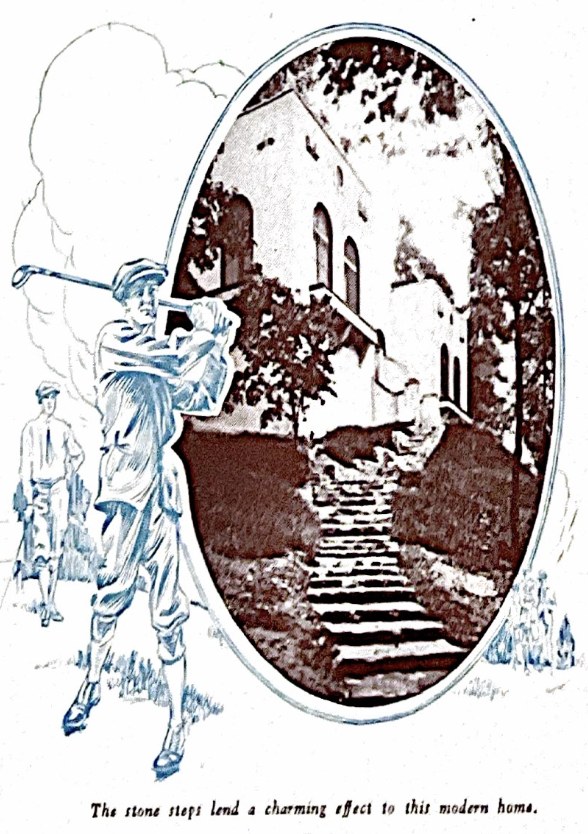
The Hills of Northern Virginia Promotional Brochure, 1926. Courtesy, CCCLH, Arlington Public Library.
The County’s rural patchwork of land parcels was advertised to prospective buyers as a place for both “good homes” and for an “investment.” As early as 1892, buyers were enticed with “beautiful views,” “pure water,”
and easy access to the city.
1
The idea that a home could be an investment was relatively new at the time. The following language appeared in ads for High View Park, a vibrant African American community in Arlington. High View Park was advertised as
a place “...for all, rich and poor, white and colored” with “(t)he terms of sale …such as to put in the power of everyone to own a lot or a home.”
2
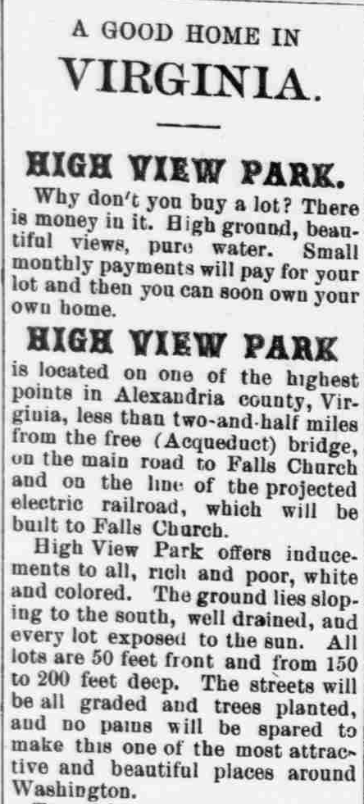
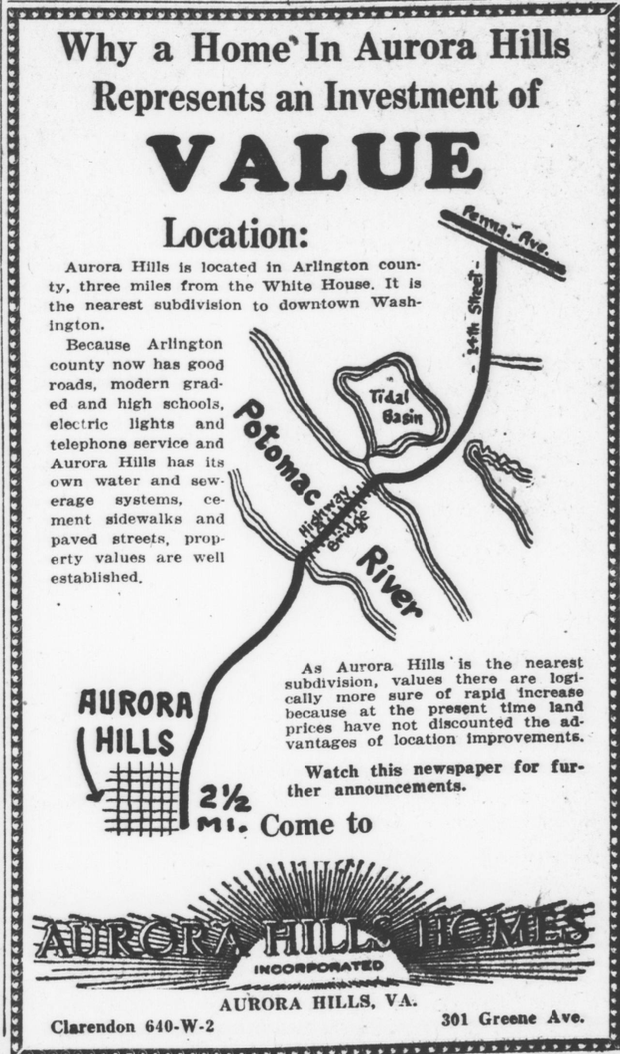
By the 1920s, similar housing ads appeared for Arlington’s Caucasian-restricted subdivisions such as Aurora Hills, highlighting the idea that a home represented an “investment of value.” 3 By the 1930s and 1940s, the county’s large parcels of land provided ideal market opportunities for new residents who were coming to the area for federal government job opportunities. As a result, housing investment in Arlington County continued to be viewed as a good value.

An ever-increasing number of subdivisions were built in Arlington, sustaining what was described as a real estate boom in the 1920s. 4 Federal programs and policies were increasingly used to spur housing construction and revive the real estate industry. While this construction trend occurred in Arlington’s African American communities, such policies did not support the same rate of growth experienced in the white communities. 5 African American families moving to the area settled across Arlington, with the practice of subdividing lots to make room for an influx of newcomers becoming commonplace. By 1950 many of these smaller African American communities disappeared. 6
Arlington County was billed as a place for “all tastes and purses” in the 1926 “Hills of Northern Virginia” promotional brochure. 7 Over time, in response to Federal Housing Administration (FHA) recommendations for addressing market demand, local realtors and developers developed a broader range of housing options. 8
Image above right: The Hills of Northern Virginia Promotional Brochure, 1926. Courtesy, CCCLH, Arlington Public Library.
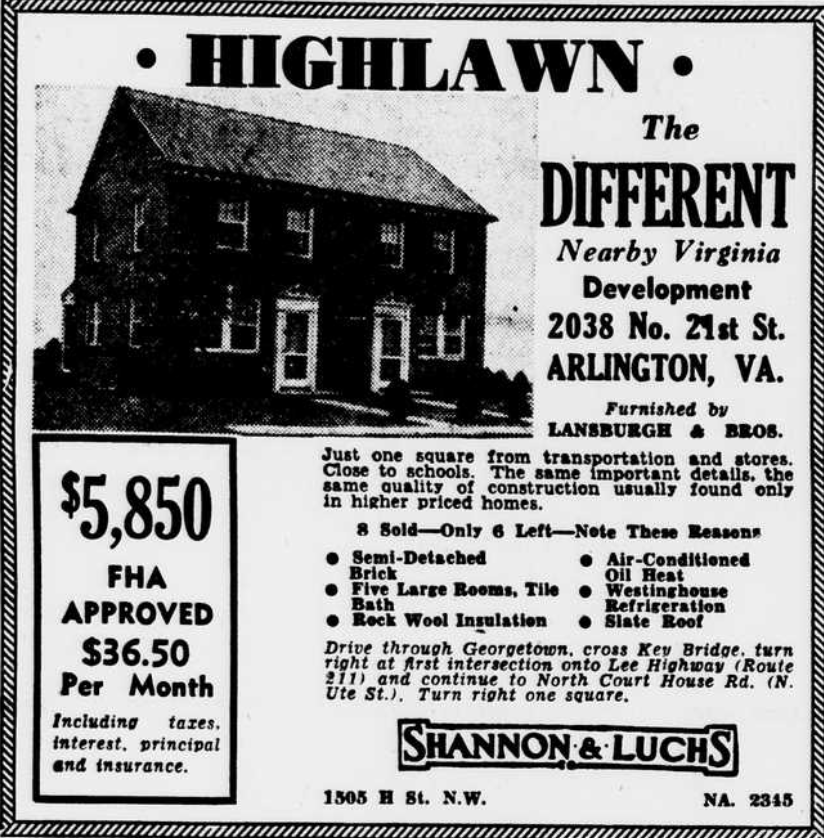
This FHA guidance translated into housing options that included a few exclusive homes (such as Country Club Hills), semi-detached homes (such as Highlawn), with the majority of Arlington’s residential subdivisions composed of single family detached homes that appealed to families of modest means (such as Parkhurst). 9 The following ads appeared in The Evening Star from the Chronicling America collection of the Library of Congress:
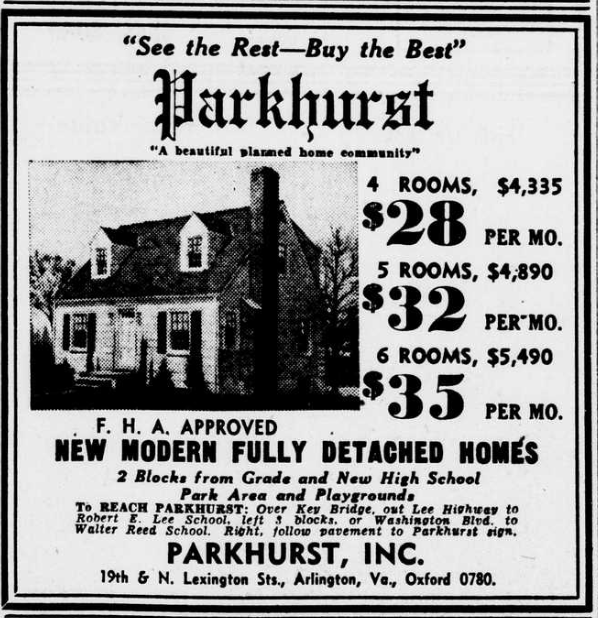
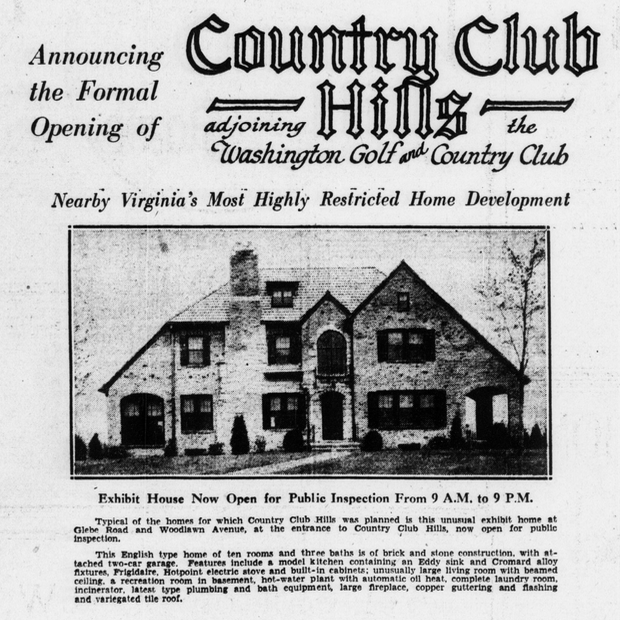
Because land was less expensive in Arlington, investors addressed growing housing needs by building low-cost, low density, multi-family developments in the outskirts of DC. 10 Colonial Village became a national prototype for low rise, or garden apartments. Constructed in 1936, this complex was reported to be in high demand, with the first 276 units receiving 10,000 applicants. 11 Other low-cost housing options were built to serve the federal wartime workers who were coming to this area [see Defense Worker and Veteran Housing].
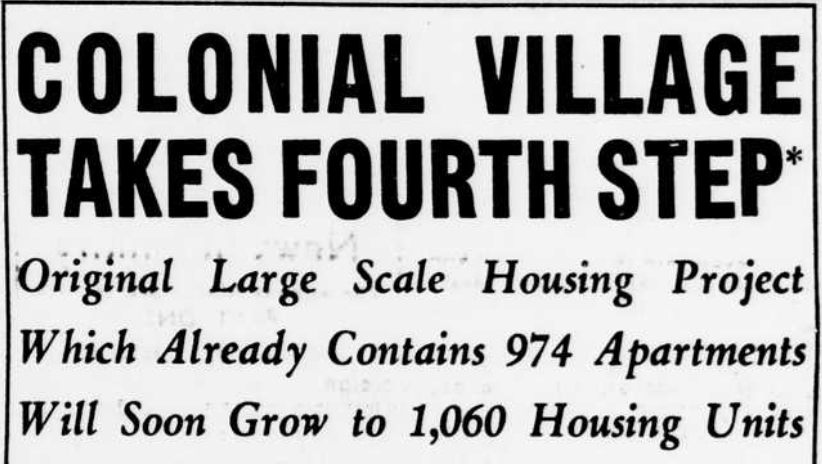
Arlington’s community leaders pressed for expansion of local government regulation over land use planning and development, as encouraged by leaders at the national level. 12 It would not be long before civic leaders acknowledged that other sources of funding would become necessary to sustain Arlington’s pleasant way of life.
Early in the 1900s, those who were interested in purchasing land used cash on hand or made, often short term, private payment arrangements with a lender. It was not until the 1930s that New Deal programs introduced long-term mortgage loans, providing some Arlingtonians with a greater chance to own their homes. Specifically, access to government backed loans through the FHA, and later VA, made it possible for more families to become homeowners [but see “Federal Housing Initiatives Promote Covenants” – Racial Covenant].
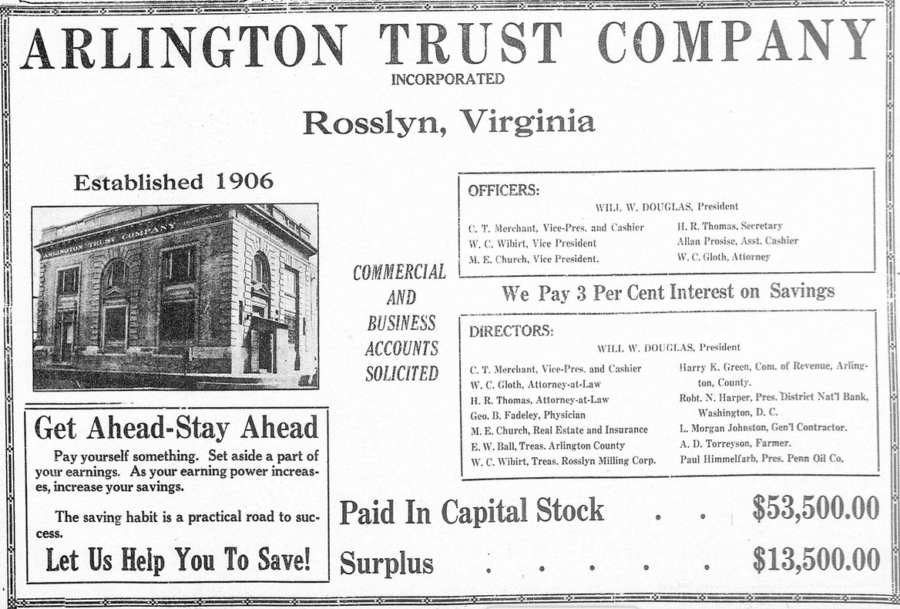
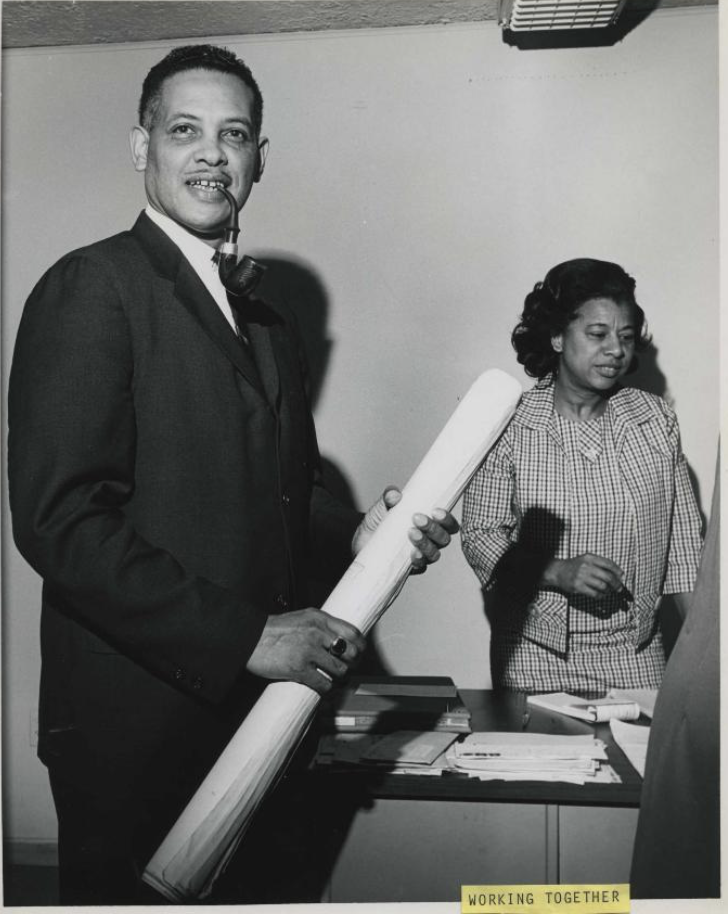
The opportunities created by FHA and VA backed loans were not made available for homes built in African American neighborhoods. Therefore, when possible, African American community leaders stepped in to facilitate access to financing for community members. In some cases their working relationships with local white investors allowed them to secure loans for individual homebuyers. William T. Syphax explained how he leveraged personal working relationships with Arlington real estate operators to build homes and apartment complexes for African American families [see In their words].
1 “
A Good Home in Virginia, High View Park,” The Washington Bee (Washington DC), September 17, 1892, accessed December 10, 2024, Chronicling America: Historic American Newspapers.
2.The Washington Bee was a DC-based newspaper that was concerned with civil rights issues and was considered “one of the most influential African American newspapers in the country.” About the Washington Bee (Washington, D.C.) 1884-1922, accessed December 10,2024, Chronicling America: Historic American Newspapers. “ A Good Home in Virginia, High View Park,” The Washington Bee (Washington DC), September 17, 1892, accessed December 10, 2024, Chronicling America: Historic American Newspapers.
3[Advertisement – Aurora Hills], The Washington Times (Washington DC), September 28, 1925, accessed December 10, 2024, Chronicling America: Historic American Newspapers.
4 ” Arlington County Real Estate Booming,” Washington Times (Washington DC), August 29 1925, accessed December 10, 2024, Chronicling America: Historic American Newspapers.
5 Nancy Perry, Spencer Crew, Nigel M. Waters, “‘We didn’t have any other place to live’: Residential Patterns in Segregated Arlington County, Virginia,” Southeastern Geographer 53, no. 4 (Winter 2013): 403-427.
6 The Hills of Northern Virginia (Washington, D.C.: Northern Virginia Bureau, 1926), Charlie Clark Center for Local History, Arlington Public Library.
7.Nancy Perry, “African American Life In Arlington, Virginia, During Segregation: A Geographer’s Point Of View” The Metropole (blog), Urban History Association, February 21, 2019, accessed December 10, 2024, https://themetropole.blog/2019/02/21/african-american-life-in-arlington-virginia-during-segregation-a-geographers-point-of-view/.
8 Miles Colean, “Large Scale Housing General Objectives,” p. 40, in “Garden Apartments, Apartment Houses and Apartment Complexes in Arlington County, Virginia: 1934-1954,” National Register of Historic Places Multiple Property Documentation Form, December 11, 2002, accessed December 10, 2024, https://www.dhr.virginia.gov/historic-registers/000-8825/.
9 [Advertisement – Highlawn], Evening Star (Washington, DC) November 04, 1939; [Advertisement – Parkhurst], Evening Star (Washington DC) May 4, 1940; [Advertisement – Country Club Hills], Evening Star (Washington DC) May 18, 1929, accessed December 10, 2024, Chronicling America: Historic American Newspapers.
10 “Garden Apartments, Apartment Houses and Apartment Complexes in Arlington County, Virginia: 1934-1954”.
11 “Garden Apartments, Apartment Houses and Apartment Complexes in Arlington County, Virginia: 1934-1954”.
12 US Department of Commerce, Advisory Committee on Zoning, A standard State Zoning Enabling Act under which Municipalities May Adopt Zoning Regulations (Washington, DC: Government Printing Office, 1926).